03 · Multi-Condition ANOVA

Welch’s one-way ANOVA with planned contrasts and Holm correction

infection
statistics
ANOVA

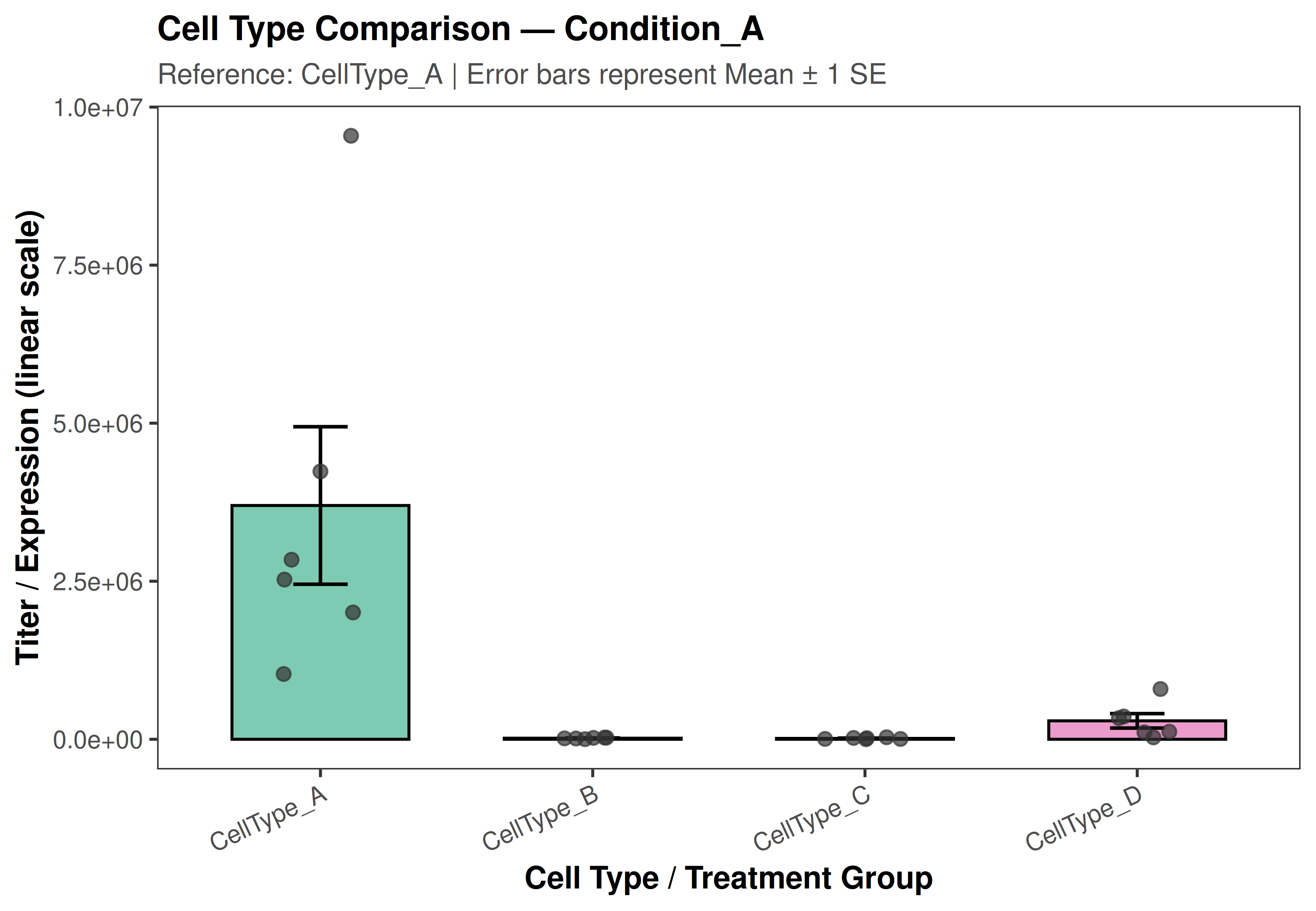
Compares multiple cell types or treatment conditions across one or more viral/experimental conditions. Uses Welch’s ANOVA (robust to unequal variances) on log₁₀-transformed data, with planned pairwise contrasts against a reference group and Holm multiple-testing correction.

Overview

Item Details
Input Wide-format CSV per condition (columns = cell types, rows = replicates)
Key packages tidyverse, car, broom
Statistics Shapiro-Wilk, Bartlett, Levene, Welch one-way ANOVA, Welch t-tests
Correction Holm (FWER)
Output Diagnostic table · ANOVA result · Contrast table with fold-changes
Download template.Rmd
Tip

When to use this template: You have measurements (e.g., viral titres, protein levels) across several cell types or treatment groups, and you need to test whether a reference group differs from the others, accounting for potential heteroscedasticity.

Back to Gallery Open Template File

Code
## ── USER CONFIGURATION ──────────────────────────────────────────────────────
#
# CONDITION_FILES: Named character vector of CSV files to load.
#   Names become the "condition" label in all outputs.
#   Each CSV must be wide-format: one column per cell type / sample group,
#   with replicate runs stored as "CellType.1", "CellType.2" … suffix columns.
#   (This is the format produced by many plate-reader and CQ1 exports.)
#
CONDITION_FILES <- c(
  "Condition_A" = "data/Condition_A.csv",
  "Condition_B" = "data/Condition_B.csv",
  "Condition_C" = "data/Condition_C.csv"
)

# FOCAL_CONDITION: Which condition to run the planned-contrast analysis on.
#   Must match one of the names() of CONDITION_FILES exactly.
FOCAL_CONDITION <- "Condition_A"

# REFERENCE_GROUP: The cell type / sample group used as the reference in
#   planned comparisons (i.e., all other groups are tested against this one).
REFERENCE_GROUP <- "CellType_A"

# LOG_TRANSFORM: Apply log10 before analysis? Almost always TRUE for viral
#   titres and NGS read-count data.
LOG_TRANSFORM <- TRUE

# ALPHA: Significance threshold for all tests.
ALPHA <- 0.05

## ────────────────────────────────────────────────────────────────────────────
Code
# ── 0. Libraries ──────────────────────────────────────────────────────────────
library(tidyverse)
library(car)
library(broom)

Load Data

Code
# ── 1. Read and tidy all condition files ──────────────────────────────────────
#
# clean_one() expects a wide CSV where:
#   • Each column = a cell-type / treatment group
#   • Replicate columns follow the "<name>.1", "<name>.2" … convention
#   • Missing values (NA) are silently dropped

clean_one <- function(path, condition_label) {
  read_csv(path, show_col_types = FALSE) %>%
    select(-matches("^Unnamed")) %>%                       # drop blank index cols
    pivot_longer(
      everything(),
      names_to  = "cell_type_raw",
      values_to = "value"
    ) %>%
    filter(!is.na(value)) %>%
    mutate(
      cell_type = str_remove(cell_type_raw, "\\.[0-9]+$") %>%   # strip ".1"
                  str_remove("\\.+$"),                           # strip trailing dots
      replicate = if_else(
        str_detect(cell_type_raw, "\\.[0-9]+$"),
        as.integer(str_extract(cell_type_raw, "\\d+$")) + 1L,
        1L
      ),
      condition   = condition_label,
      log_value   = if (LOG_TRANSFORM) log10(value) else value
    ) %>%
    select(condition, cell_type, replicate, value, log_value)
}

all_data <- imap_dfr(CONDITION_FILES, ~ clean_one(.x, .y))

all_data
# A tibble: 72 × 5
   condition   cell_type  replicate    value log_value
   <chr>       <chr>          <int>    <dbl>     <dbl>
 1 Condition_A CellType_A         1 9546308.      6.98
 2 Condition_A CellType_B         1   26394.      4.42
 3 Condition_A CellType_C         1   21332.      4.33
 4 Condition_A CellType_D         1  119688.      5.08
 5 Condition_A CellType_A         2 9546308.      6.98
 6 Condition_A CellType_B         2   26394.      4.42
 7 Condition_A CellType_C         2   21332.      4.33
 8 Condition_A CellType_D         2  119688.      5.08
 9 Condition_A CellType_A         1 2006114.      6.30
10 Condition_A CellType_B         1   21953.      4.34
# ℹ 62 more rows

Assumption Checks

Code
# ── 2. Shapiro-Wilk, Bartlett, and Levene tests per condition ─────────────────
diagnostics <- all_data %>%
  group_by(condition) %>%
  summarise(
    shapiro_raw  = shapiro.test(value)$p.value,
    shapiro_log  = shapiro.test(log_value)$p.value,
    bartlett_log = bartlett.test(log_value ~ cell_type)$p.value,
    levene_log   = car::leveneTest(
      log_value ~ factor(cell_type),
      center = median
    )[["Pr(>F)"]][1],
    .groups = "drop"
  )

diagnostics
# A tibble: 3 × 5
  condition    shapiro_raw shapiro_log bartlett_log levene_log
  <chr>              <dbl>       <dbl>        <dbl>      <dbl>
1 Condition_A 0.000000315       0.0167       0.148       0.370
2 Condition_B 0.00000326        0.204        0.232       0.393
3 Condition_C 0.0000000281      0.0104       0.0438      0.400

Interpretation Guide

  • Raw data from viral infections are typically log-normally distributed — expect low Shapiro-Wilk p-values on raw values.
  • Log₁₀ transform symmetrises the distribution and stabilises variance. Check shapiro_log > 0.05.
  • Bartlett / Levene tests flag heteroscedasticity. If these are significant for your focal condition, Welch’s ANOVA (used below) is the correct choice.

Why Welch’s One-Way ANOVA on log₁₀ data?

  1. Handles heteroscedasticity — group-specific variances are allowed.
  2. Tolerates moderate non-normality — log transform already reduces most skew.
  3. More powerful than Kruskal-Wallis at typical n = 3–6 per group.
  4. Pairs with Holm correction for planned comparisons (controls family-wise error rate without being overly conservative).

Focal Condition Analysis

Code
# ── 3. Subset focal condition ─────────────────────────────────────────────────
focal <- all_data %>%
  filter(condition == FOCAL_CONDITION, !is.na(log_value)) %>%
  mutate(cell_type = factor(cell_type))

# ── 4. Welch one-way ANOVA ────────────────────────────────────────────────────
welch_anova <- oneway.test(log_value ~ cell_type,
                           data      = focal,
                           var.equal = FALSE)

cat(sprintf(
  "Welch one-way ANOVA — %s\n  F(%.1f, %.1f) = %.3f,  p = %.4f\n",
  FOCAL_CONDITION,
  welch_anova$parameter["num df"],
  welch_anova$parameter["denom df"],
  welch_anova$statistic,
  welch_anova$p.value
))
Welch one-way ANOVA — Condition_A
  F(3.0, 9.8) = 102.794,  p = 0.0000

Planned Contrasts: Reference Group vs All Others

Code
# ── 5. Welch t-tests: REFERENCE_GROUP vs every other cell type ────────────────
other_groups <- levels(focal$cell_type)[levels(focal$cell_type) != REFERENCE_GROUP]

contrasts <- map_df(other_groups, function(grp) {
  t_out <- t.test(
    focal$log_value[focal$cell_type == REFERENCE_GROUP],
    focal$log_value[focal$cell_type == grp],
    var.equal = FALSE
  )
  tibble(
    comparison  = paste(REFERENCE_GROUP, "vs", grp),
    log_diff    = unname(t_out$estimate[1] - t_out$estimate[2]),
    p_raw       = t_out$p.value
  )
}) %>%
  mutate(
    p_adj       = p.adjust(p_raw, method = "holm"),
    fold_change = round(10^(-log_diff), 1),
    significant = p_adj < ALPHA
  ) %>%
  arrange(p_adj)

contrasts
# A tibble: 3 × 6
  comparison               log_diff       p_raw    p_adj fold_change significant
  <chr>                       <dbl>       <dbl>    <dbl>       <dbl> <lgl>      
1 CellType_A vs CellType_C     2.44 0.000000164  4.93e-7         0   TRUE       
2 CellType_A vs CellType_B     2.33 0.00000104   2.08e-6         0   TRUE       
3 CellType_A vs CellType_D     1.12 0.000209     2.09e-4         0.1 TRUE       

Summary

Code
cat(sprintf(
  "\nFocal condition: %s\nReference group: %s\nSignificant contrasts (Holm-adjusted p < %.2f): %d / %d\n",
  FOCAL_CONDITION,
  REFERENCE_GROUP,
  ALPHA,
  sum(contrasts$significant),
  nrow(contrasts)
))

Focal condition: Condition_A
Reference group: CellType_A
Significant contrasts (Holm-adjusted p < 0.05): 3 / 3