01 · Plaque Assay + Violin Plots

Viral titer quantification with replicate QC and significance testing

infection
virology
ANOVA
plaque-assay

Analyzes plaque assay data from viral infection studies. Performs replicate agreement (Limits of Agreement), one-way ANOVA with Tukey HSD, and produces publication-quality violin plots on a log10 titer scale.

Overview

Item Details
Input Single CSV — one row per animal, columns for two plaque count replicates and calculated titer
Key packages ggplot2, ggpubr, rstatix, car, gt, scales
Statistics Limits of Agreement · Shapiro-Wilk · Levene · One-way ANOVA · Tukey HSD
Output Replicate QC plot · Violin plots (full + merged) · ANOVA + post-hoc tables
Download template.Rmd
Tip

When to use this template: You have viral plaque assay data with duplicate plaque counts per animal across multiple treatment groups, and you want to visualize titer distributions and test for significant differences.

Back to Gallery Open Template File

Code
## ── USER CONFIGURATION ──────────────────────────────────────────────────────
#
# DATA_FILE: Path to your CSV file with plaque assay data.
#   Expected columns (rename yours to match, or update the rename() call below):
#   - "Mouse ID"              : animal/sample identifier
#   - "Group"                 : group label (e.g., "Group 1", "Group 2")
#   - "Virus"                 : virus or mock label used in sample
#   - "# plaques counted R1"  : plaque count replicate 1
#   - "# plaques counted R2"  : plaque count replicate 2
#   - "Average plaques from duplicate wells in a 12-well plate"
#   - "Plated 10e-1 to 10e-6 dilution"
#   - "Total Volume (ml)"
#   - "pfu/mL right-side lung homogenate"  : calculated viral titer
#
DATA_FILE <- "data/titer_data.csv"

# EXCLUDE_PATTERN: Regex to drop rows you do not want (e.g., backtitrations).
#   Set to NULL to keep all rows.
EXCLUDE_PATTERN <- NULL   # e.g., "backtitration"

# GROUP_MAP: Named character vector mapping your "Group N" labels to
#   human-readable short names used in all plots and tables.
#   Keys  = values in the "Group" column of your CSV.
#   Values = display names (shown on plot axes).
#
#   NOTE: for the shipped demo data this mapping is asserted against the
#   simulator (data/simulate_data.R defines the same Group -> label pairs in
#   GROUP_DEFS). Every group present in the CSV must appear as a key here —
#   the template stops with an error otherwise, rather than silently dropping
#   unmapped animals from the plots and the ANOVA.
GROUP_MAP <- c(
  "Group 1" = "Mock + Compound A",
  "Group 2" = "Mock + Compound B",
  "Group 3" = "Compound A",
  "Group 4" = "Compound B",
  "Group 5" = "Drug X",
  "Group 6" = "Compound A + Drug X",
  "Group 7" = "Compound B + Drug X",
  "Group 8" = "Vehicle"
)

# GROUP_ORDER: Display order on the x-axis. Must contain the same strings
#   as the values of GROUP_MAP.
GROUP_ORDER <- c(
  "Mock + Compound A",
  "Mock + Compound B",
  "Vehicle",
  "Drug X",
  "Compound A",
  "Compound A + Drug X",
  "Compound B",
  "Compound B + Drug X"
)

# PALETTE_GROUPS: Fill color for each group in the full violin plot.
#   Names must match the values of GROUP_MAP / GROUP_ORDER.
PALETTE_GROUPS <- c(
  "Mock + Compound A"    = "grey85",
  "Mock + Compound B"    = "grey70",
  "Vehicle"              = "grey40",
  "Drug X"               = "#984ea3",
  "Compound A"           = "#74add1",
  "Compound B"           = "#4575b4",
  "Compound A + Drug X"  = "#66c2a5",
  "Compound B + Drug X"  = "#238b45"
)

# MERGE_MAP: Optionally collapse related groups for the combined-group plot.
#   Keys = ShortGroup values; Values = merged display name.
#   Groups not listed here are kept as-is.
MERGE_MAP <- c(
  "Mock + Compound A"    = "Mock",
  "Mock + Compound B"    = "Mock",
  "Compound A"           = "Inhibitor",
  "Compound B"           = "Inhibitor",
  "Compound A + Drug X"  = "Drug + Inhibitor",
  "Compound B + Drug X"  = "Drug + Inhibitor",
  "Vehicle"              = "Vehicle",
  "Drug X"               = "Drug X"
)

# MERGE_ORDER: Display order for the combined-group violin plot.
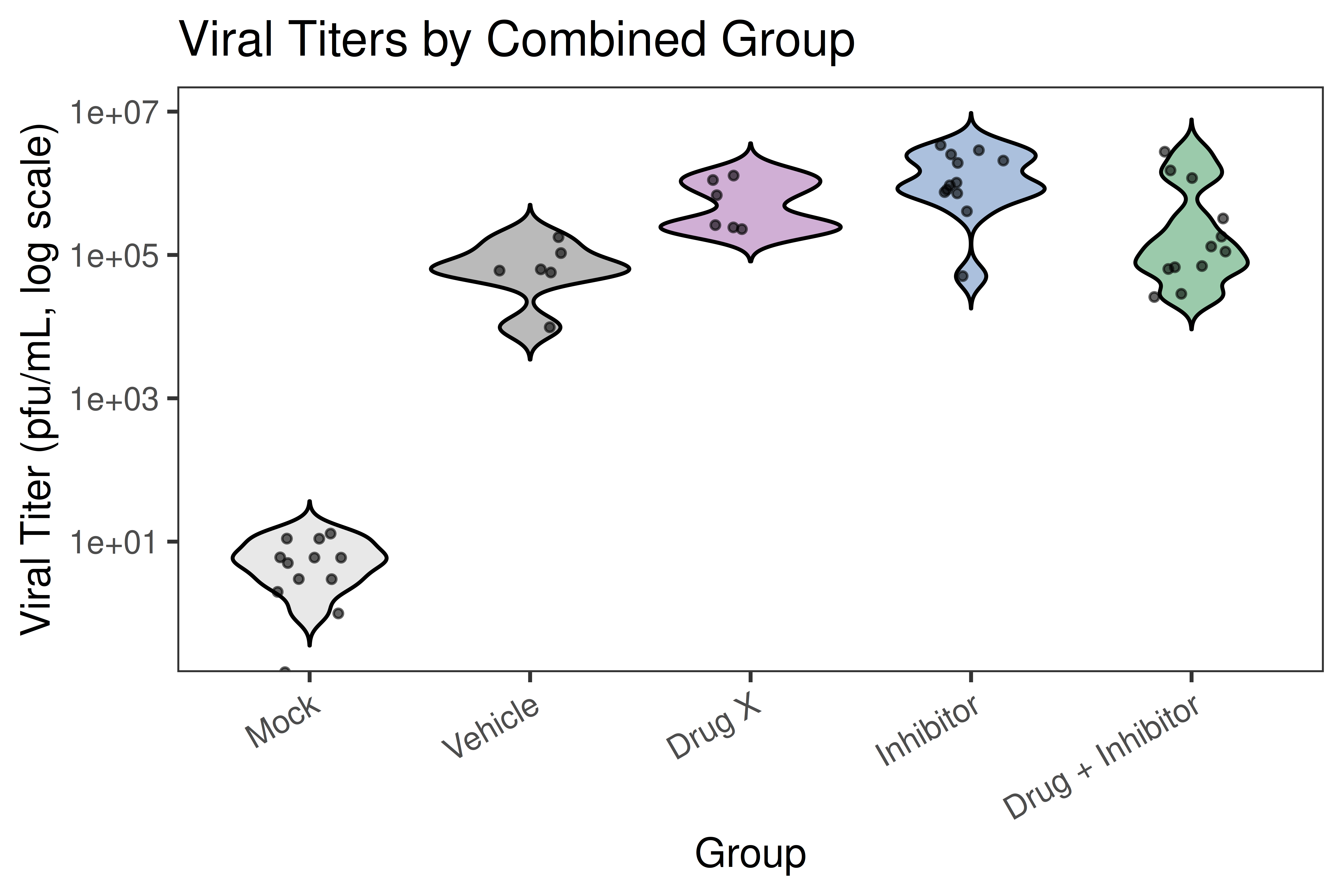
MERGE_ORDER <- c("Mock", "Vehicle", "Drug X", "Inhibitor", "Drug + Inhibitor")

# PALETTE_MERGED: Fill colors for the combined-group violin plot.
PALETTE_MERGED <- c(
  "Mock"            = "grey80",
  "Vehicle"         = "grey40",
  "Drug X"          = "#984ea3",
  "Inhibitor"       = "#4575b4",
  "Drug + Inhibitor"= "#238b45"
)

# COMPARISONS: Pairs of merged groups to test with stat_compare_means().
#   Each element is a length-2 character vector of MERGE_ORDER values.
COMPARISONS <- list(
  c("Drug X", "Inhibitor"),
  c("Drug X", "Drug + Inhibitor"),
  c("Inhibitor", "Drug + Inhibitor")
)

# TITER_COL: Column name in your CSV that holds the computed titer value.
TITER_COL <- "pfu/mL right-side lung homogenate"

# PSEUDOCOUNT: Added to the titer before log10 so that true zeros (below the
#   limit of detection) survive both the statistics AND the log-scaled figures.
#   Use the same value everywhere — never log10() a raw titer.
PSEUDOCOUNT <- 1

# ALPHA: Significance threshold used for assumption checks and for deciding
#   which Tukey comparisons get a bracket on the final figure.
ALPHA <- 0.05

# LOA_MULTIPLIER: Width of the replicate limits of agreement, in SDs of the
#   replicate difference (1.96 = 95% LoA).
LOA_MULTIPLIER <- 1.96

# OUTPUT_DIR: Where figures are written. Created if it does not exist.
OUTPUT_DIR <- "Plots"

# Figure export settings (applied to every ggsave() call below).
FIG_WIDTH  <- 8      # inches
FIG_HEIGHT <- 5      # inches
FIG_DPI    <- 600

# VIOLIN_BW: Kernel bandwidth for geom_violin, on the log10 scale.
#   Increase for smoother violins, decrease for more detail.
VIOLIN_BW <- 0.15

## ────────────────────────────────────────────────────────────────────────────

Setup

Libraries

Code
library(readr)
library(dplyr)
library(janitor)
library(stringr)
library(ggplot2)
library(scales)
library(rstatix)
library(car)
library(ggpubr)
library(gt)
library(broom)

Load Data

Code
if (!file.exists(DATA_FILE)) {
  stop("DATA_FILE not found: '", DATA_FILE, "'. ",
       "Run `Rscript data/simulate_data.R` from the template directory to ",
       "regenerate the demo data, or point DATA_FILE at your own CSV.")
}

df <- read_csv(DATA_FILE)

# ── Input validation ─────────────────────────────────────────────────────────
# Fail loudly and early rather than producing plots from a partially parsed
# file. Every column renamed in the next chunk must exist.
REQUIRED_COLS <- c(
  "Mouse ID", "Group",
  "# plaques counted R1", "# plaques counted R2",
  "Average plaques from duplicate wells in a 12-well plate",
  "Plated 10e-1 to 10e-6 dilution", "Total Volume (ml)",
  TITER_COL
)
missing_cols <- setdiff(REQUIRED_COLS, names(df))
if (length(missing_cols) > 0) {
  stop("DATA_FILE is missing required column(s): ",
       paste(sQuote(missing_cols), collapse = ", "),
       ". Rename your columns to match, or edit REQUIRED_COLS and the ",
       "rename() call in the next chunk.")
}

# Every group in the data must be mapped, or it silently disappears from the
# figures and the ANOVA when factor(levels = GROUP_ORDER) turns it into NA.
unmapped_groups <- setdiff(unique(df$Group), names(GROUP_MAP))
if (length(unmapped_groups) > 0) {
  stop("Group value(s) present in the data but absent from GROUP_MAP: ",
       paste(sQuote(unmapped_groups), collapse = ", "),
       ". Add them to GROUP_MAP (and to GROUP_ORDER / PALETTE_GROUPS / MERGE_MAP).")
}
stopifnot(all(unique(df$Group) %in% names(GROUP_MAP)))

# The display vocabularies must agree with each other too.
stopifnot(
  all(GROUP_MAP   %in% GROUP_ORDER),
  all(GROUP_ORDER %in% GROUP_MAP),
  all(GROUP_ORDER %in% names(PALETTE_GROUPS)),
  all(GROUP_ORDER %in% names(MERGE_MAP)),
  all(MERGE_MAP   %in% MERGE_ORDER),
  all(MERGE_ORDER %in% names(PALETTE_MERGED)),
  all(unlist(COMPARISONS) %in% MERGE_ORDER)
)

dir.create(OUTPUT_DIR, showWarnings = FALSE, recursive = TRUE)

Clean and Organize

Code
df_clean <- df %>%
  { if (!is.null(EXCLUDE_PATTERN)) filter(., !str_detect(Group, EXCLUDE_PATTERN)) else . } %>%
  rename(
    MouseID    = `Mouse ID`,
    Plaques_R1 = `# plaques counted R1`,
    Plaques_R2 = `# plaques counted R2`,
    AvgPlaques = `Average plaques from duplicate wells in a 12-well plate`,
    Dilution   = `Plated 10e-1 to 10e-6 dilution`,
    Volume_mL  = `Total Volume (ml)`,
    Titer      = all_of(TITER_COL)
  ) %>%
  mutate(
    ShortGroup  = coalesce(unname(GROUP_MAP[Group]), Group),
    MergedGroup = coalesce(unname(MERGE_MAP[ShortGroup]), ShortGroup),
    ShortGroup  = factor(ShortGroup, levels = GROUP_ORDER),
    MergedGroup = factor(MergedGroup, levels = MERGE_ORDER),
    mean_plaques  = (Plaques_R1 + Plaques_R2) / 2,
    diff_plaques  = Plaques_R1 - Plaques_R2,
    # Titer_pseudo is what every log-scaled FIGURE plots, and logTiter is what
    # every TEST uses. Both carry the same pseudocount, so figure n == test n
    # and animals at the limit of detection (Titer == 0) are never dropped.
    Titer_pseudo  = Titer + PSEUDOCOUNT,
    logTiter      = log10(Titer + PSEUDOCOUNT)
  )

# The GROUP_MAP / MERGE_MAP checks above guarantee every row is mapped; assert
# the factor conversion did not introduce NAs anyway (e.g. from a stray level).
stopifnot(
  !any(is.na(df_clean$ShortGroup)),
  !any(is.na(df_clean$MergedGroup))
)

# ── Limit of Agreement (LoA) ─────────────────────────────────────────────────
loa_stats <- df_clean %>%
  summarise(
    bias    = mean(diff_plaques, na.rm = TRUE),
    sd_diff = sd(diff_plaques, na.rm = TRUE)
  )
loa_upper <- loa_stats$bias + LOA_MULTIPLIER * loa_stats$sd_diff
loa_lower <- loa_stats$bias - LOA_MULTIPLIER * loa_stats$sd_diff

df_clean <- df_clean %>%
  mutate(
    flag_bad_replicate = diff_plaques < loa_lower | diff_plaques > loa_upper
  )

Check Replicates

Code
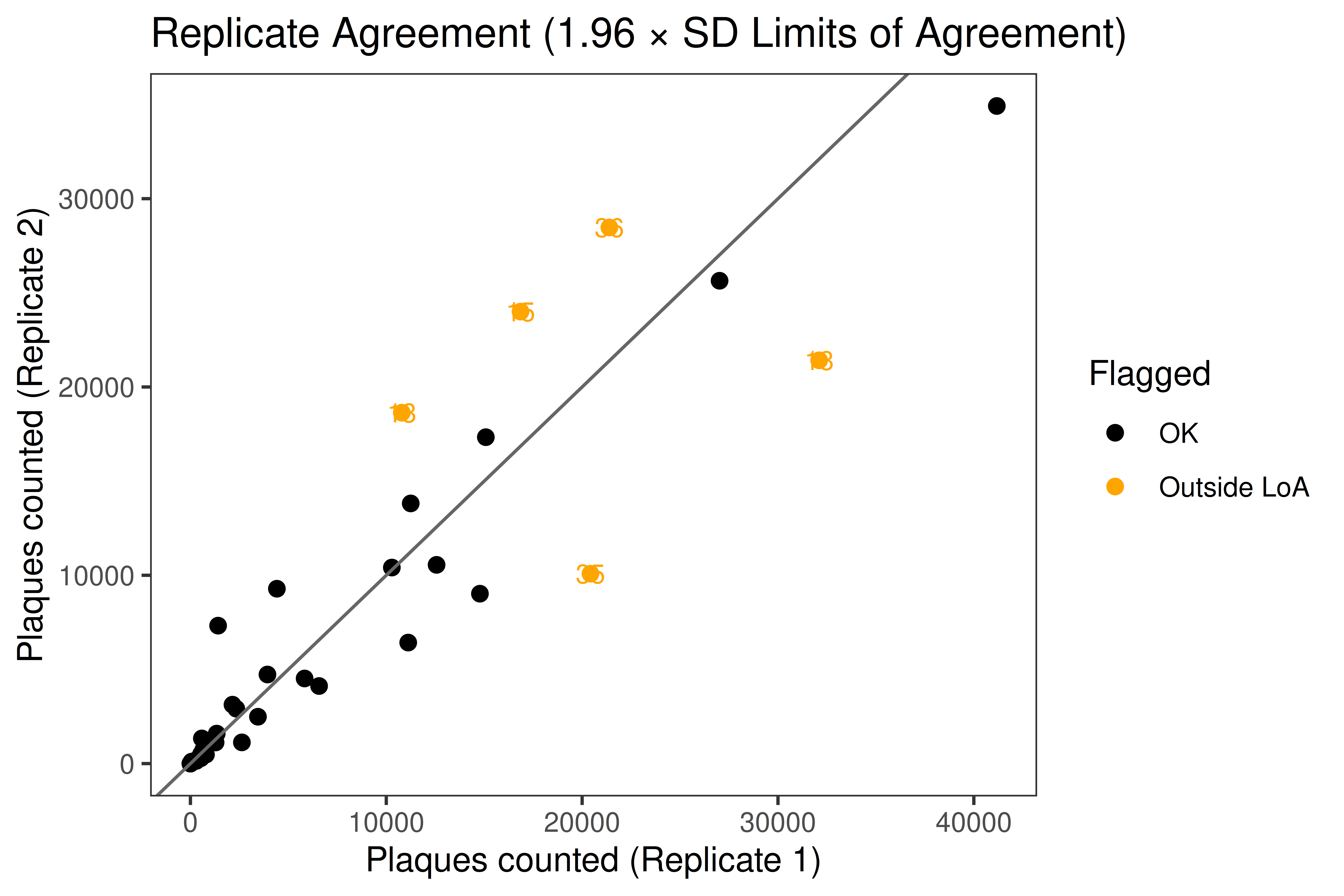
labeled_points <- filter(df_clean, flag_bad_replicate)

print(
  ggplot(df_clean, aes(x = Plaques_R1, y = Plaques_R2, color = flag_bad_replicate)) +
    geom_point(size = 2) +
    geom_abline(slope = 1, intercept = 0, color = "grey40") +
    geom_text(
      data    = labeled_points,
      mapping = aes(
        x = Plaques_R1,
        y = Plaques_R2,
        label = as.character(MouseID)
      ),
      nudge_y = 1, size = 3, color = "orange", inherit.aes = FALSE
    ) +
    scale_color_manual(values = c("black", "orange"), labels = c("OK", "Outside LoA")) +
    labs(
      x     = "Plaques counted (Replicate 1)",
      y     = "Plaques counted (Replicate 2)",
      color = "Flagged",
      title = paste0("Replicate Agreement (", LOA_MULTIPLIER,
                     " × SD Limits of Agreement)")
    ) +
    theme_bw() +
    theme(
      panel.grid.major = element_blank(),
      panel.grid.minor = element_blank()
    )
)

Data points outside the LoA are flagged in orange. Review these samples before proceeding.

Plots

Full Group Violin Plot

Code
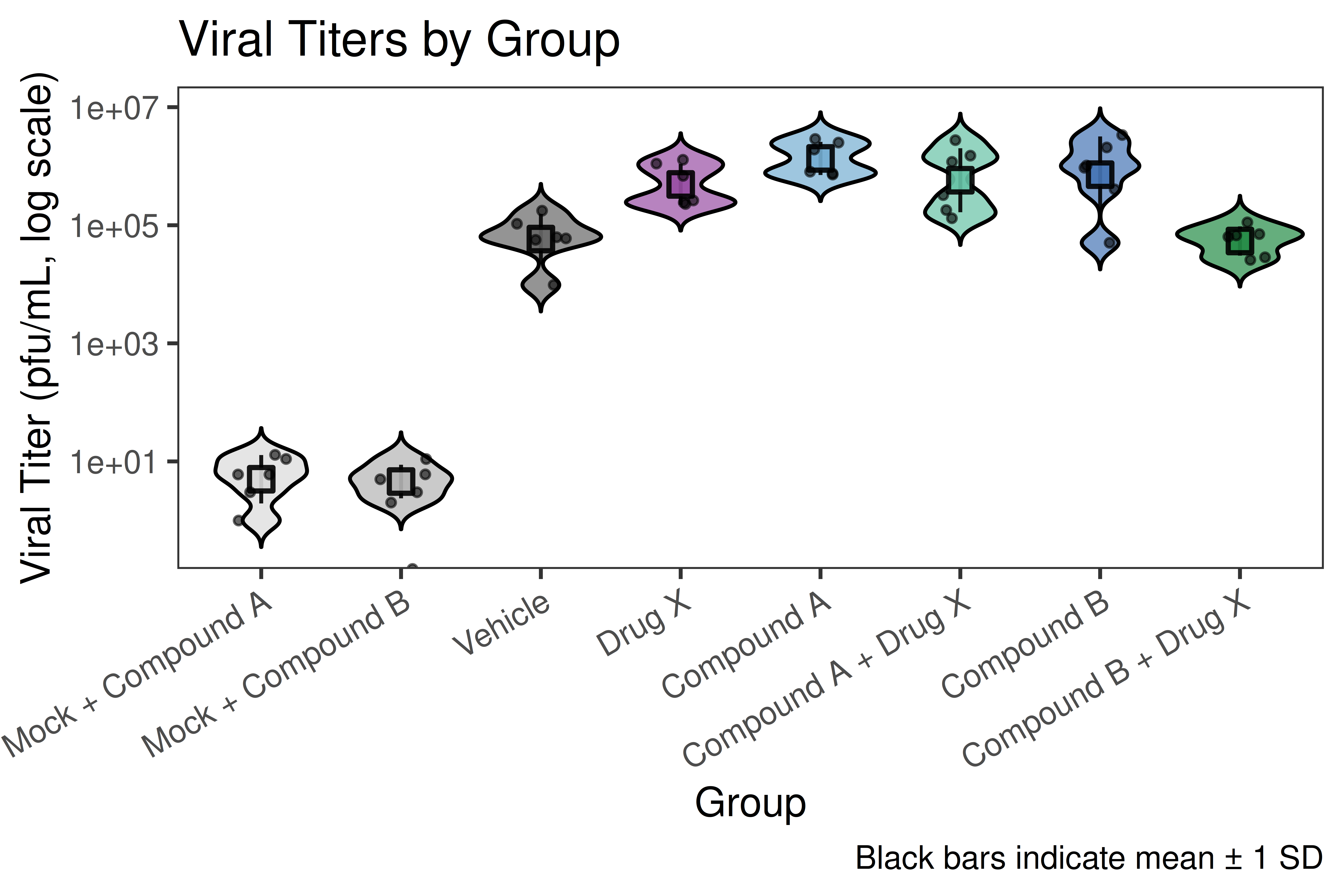
p_full <- ggplot(df_clean, aes(x = ShortGroup, y = Titer_pseudo, fill = ShortGroup)) +
  geom_violin(trim = FALSE, alpha = 0.7, color = "black", bw = VIOLIN_BW) +
  stat_summary(
    fun.data = mean_sdl,
    fun.args = list(mult = 1),
    geom = "pointrange", color = "black", size = 0.8, alpha = 0.9, shape = 22
  ) +
  geom_jitter(width = 0.18, size = 1, alpha = 0.60) +
  scale_fill_manual(values = PALETTE_GROUPS, guide = "none") +
  scale_y_log10(labels = scales::label_scientific()) +
  labs(
    x       = "Group",
    y       = paste0("Viral Titer + ", PSEUDOCOUNT, " (pfu/mL, log scale)"),
    title   = "Viral Titers by Group",
    caption = paste0("Black bars indicate mean \u00b1 1 SD. Titers are plotted as ",
                     "Titer + ", PSEUDOCOUNT,
                     " so that animals at the limit of detection remain visible.")
  ) +
  theme_bw(base_size = 13) +
  theme(
    axis.text.x      = element_text(angle = 30, hjust = 1),
    panel.grid.major = element_blank(),
    panel.grid.minor = element_blank()
  )

ggsave(file.path(OUTPUT_DIR, "Viral_Titer_By_Group.tiff"), plot = p_full,
       width = FIG_WIDTH, height = FIG_HEIGHT, units = "in", dpi = FIG_DPI,
       compression = "lzw")
print(p_full)

Combined Group Violin Plot

Code
p_merged <- ggplot(df_clean, aes(x = MergedGroup, y = Titer_pseudo, fill = MergedGroup)) +
  geom_violin(trim = FALSE, alpha = 0.45, color = "black", bw = VIOLIN_BW) +
  geom_jitter(width = 0.18, size = 1, alpha = 0.60) +
  scale_fill_manual(values = PALETTE_MERGED, guide = "none") +
  scale_y_log10(labels = scales::label_scientific()) +
  labs(
    x     = "Group",
    y     = paste0("Viral Titer + ", PSEUDOCOUNT, " (pfu/mL, log scale)"),
    title = "Viral Titers by Combined Group"
  ) +
  theme_bw(base_size = 13) +
  theme(
    axis.text.x      = element_text(angle = 30, hjust = 1),
    panel.grid.major = element_blank(),
    panel.grid.minor = element_blank()
  )

ggsave(file.path(OUTPUT_DIR, "Viral_Titer_By_MergedGroup.tiff"), plot = p_merged,
       width = FIG_WIDTH, height = FIG_HEIGHT, units = "in", dpi = FIG_DPI,
       compression = "lzw")
print(p_merged)

Significance Testing

Assumption Checks

Code
# shapiro_test() errors on any group with fewer than 3 non-missing values, and
# is undefined for a group with zero variance — drop both before testing and
# report which groups were skipped instead of failing the render.
shapiro_input <- df_clean %>%
  filter(!is.na(logTiter)) %>%
  group_by(ShortGroup) %>%
  filter(dplyr::n() >= 3, sd(logTiter, na.rm = TRUE) > 0) %>%
  ungroup()

skipped_groups <- setdiff(
  as.character(unique(df_clean$ShortGroup)),
  as.character(unique(shapiro_input$ShortGroup))
)

shapiro_res <- shapiro_input %>%
  group_by(ShortGroup) %>%
  shapiro_test(logTiter)

shapiro_res %>%
  dplyr::select(Group = ShortGroup, `Statistic (W)` = statistic, `p-value` = p) %>%
  knitr::kable(caption = "Shapiro-Wilk Normality Test by Group", digits = 4)
Shapiro-Wilk Normality Test by Group
Group Statistic (W) p-value
Mock + Compound A 0.9360 0.4483
Mock + Compound B 0.9512 0.6541
Vehicle 0.8474 0.0341
Drug X 0.9487 0.6182
Compound A 0.9758 0.9612
Compound A + Drug X 0.9577 0.7501
Compound B 0.8945 0.1346
Compound B + Drug X 0.8945 0.1345
Code
if (length(skipped_groups) > 0) {
  cat("Groups skipped (n < 3 or zero variance on the log scale): ",
      paste(skipped_groups, collapse = ", "), "\n", sep = "")
}

lev_res <- leveneTest(logTiter ~ ShortGroup, data = df_clean)
lev_df  <- data.frame(
  `Source` = c("Group", "Residuals"),
  `Df`     = lev_res$Df,
  `F value` = c(lev_res$`F value`[1], NA),
  `Pr(>F)` = c(lev_res$`Pr(>F)`[1], NA),
  check.names = FALSE
)
knitr::kable(lev_df, caption = "Levene's Test for Homogeneity of Variance", digits = 4)
Levene’s Test for Homogeneity of Variance
Source Df F value Pr(>F)
Group 7 0.3328 0.937
Residuals 88 NA NA
Code
# Act on the two tables above rather than just printing them: state the verdict
# explicitly, and run Welch's ANOVA as a robustness check whenever the
# equal-variance assumption behind the classical aov()/Tukey below is rejected.
normality_ok  <- nrow(shapiro_res) == 0 || all(shapiro_res$p >= ALPHA)
levene_p      <- lev_res$`Pr(>F)`[1]
variances_ok  <- is.na(levene_p) || levene_p >= ALPHA

cat(sprintf(
  "Normality (Shapiro-Wilk, per group, alpha = %.2f): %s\n",
  ALPHA,
  if (normality_ok) "not rejected in any group"
  else paste0("REJECTED in: ",
              paste(shapiro_res$ShortGroup[shapiro_res$p < ALPHA], collapse = ", "))
))
Normality (Shapiro-Wilk, per group, alpha = 0.05): REJECTED in: Vehicle
Code
cat(sprintf(
  "Homogeneity of variance (Levene, alpha = %.2f): %s (p = %s)\n",
  ALPHA,
  if (variances_ok) "not rejected" else "REJECTED",
  format.pval(levene_p, digits = 3)
))
Homogeneity of variance (Levene, alpha = 0.05): not rejected (p = 0.937)
Code
if (!variances_ok) {
  cat("\nLevene's test is significant, so the classical ANOVA + Tukey HSD below",
      "assume more than the data support. Welch's one-way ANOVA, which does not",
      "assume equal variances, is reported here as the robustness check:\n\n")
  welch_full <- oneway.test(logTiter ~ ShortGroup, data = df_clean, var.equal = FALSE)
  print(welch_full)
  cat("\nIf the two disagree, prefer the Welch result and switch the pairwise",
      "comparisons to Games-Howell (rstatix::games_howell_test).\n")
} else {
  cat("\nEqual variances are a reasonable assumption, so the classical one-way",
      "ANOVA with Tukey HSD below is the appropriate test.\n")
}

Equal variances are a reasonable assumption, so the classical one-way ANOVA with Tukey HSD below is the appropriate test.

One-Way ANOVA — All Groups

Code
fit_full <- aov(logTiter ~ ShortGroup, data = df_clean)

tidy(fit_full) %>%
  gt() %>%
  tab_header(title = "ANOVA: log\u2081\u2080(Titer) by Group") %>%
  fmt_number(columns = c(statistic, p.value), decimals = 3) %>%
  cols_label(term = "Source", df = "df", sumsq = "Sum Sq",
             meansq = "Mean Sq", statistic = "F value", p.value = "Pr(>F)")
ANOVA: log₁₀(Titer) by Group
Source df Sum Sq Mean Sq F value Pr(>F)
ShortGroup 7 453.4511 64.7787278 506.093 0.000
Residuals 88 11.2638 0.1279978 NA NA
Code
tukey_raw <- TukeyHSD(fit_full, conf.level = 0.95)$ShortGroup
tukey_tbl <- as.data.frame(tukey_raw)
tukey_tbl$comparison <- rownames(tukey_tbl)
rownames(tukey_tbl) <- NULL
tukey_tbl <- tukey_tbl[, c("comparison", "diff", "lwr", "upr", "p adj")]
names(tukey_tbl)[5] <- "p_adj"

tukey_tbl %>%
  gt() %>%
  tab_header(title = "Tukey HSD: Pairwise Comparisons") %>%
  fmt_number(columns = c(diff, lwr, upr, p_adj), decimals = 3) %>%
  cols_label(comparison = "Comparison", diff = "Difference",
             lwr = "Lower CI", upr = "Upper CI", p_adj = "Adjusted p")
Tukey HSD: Pairwise Comparisons
Comparison Difference Lower CI Upper CI Adjusted p
Mock + Compound B-Mock + Compound A −0.070 −0.523 0.384 1.000
Vehicle-Mock + Compound A 5.589 5.136 6.043 0.000
Drug X-Mock + Compound A 5.156 4.702 5.609 0.000
Compound A-Mock + Compound A 5.205 4.752 5.659 0.000
Compound A + Drug X-Mock + Compound A 4.123 3.669 4.577 0.000
Compound B-Mock + Compound A 4.948 4.494 5.401 0.000
Compound B + Drug X-Mock + Compound A 4.175 3.721 4.628 0.000
Vehicle-Mock + Compound B 5.659 5.205 6.112 0.000
Drug X-Mock + Compound B 5.225 4.772 5.679 0.000
Compound A-Mock + Compound B 5.275 4.821 5.729 0.000
Compound A + Drug X-Mock + Compound B 4.193 3.739 4.646 0.000
Compound B-Mock + Compound B 5.017 4.564 5.471 0.000
Compound B + Drug X-Mock + Compound B 4.245 3.791 4.698 0.000
Drug X-Vehicle −0.433 −0.887 0.020 0.072
Compound A-Vehicle −0.384 −0.837 0.070 0.160
Compound A + Drug X-Vehicle −1.466 −1.920 −1.013 0.000
Compound B-Vehicle −0.642 −1.095 −0.188 0.001
Compound B + Drug X-Vehicle −1.414 −1.868 −0.961 0.000
Compound A-Drug X 0.050 −0.404 0.503 1.000
Compound A + Drug X-Drug X −1.033 −1.486 −0.579 0.000
Compound B-Drug X −0.208 −0.662 0.245 0.843
Compound B + Drug X-Drug X −0.981 −1.434 −0.527 0.000
Compound A + Drug X-Compound A −1.082 −1.536 −0.629 0.000
Compound B-Compound A −0.258 −0.711 0.196 0.645
Compound B + Drug X-Compound A −1.030 −1.484 −0.577 0.000
Compound B-Compound A + Drug X 0.825 0.371 1.278 0.000
Compound B + Drug X-Compound A + Drug X 0.052 −0.402 0.505 1.000
Compound B + Drug X-Compound B −0.773 −1.226 −0.319 0.000

One-Way ANOVA — Combined Groups

Code
fit_merged <- aov(logTiter ~ MergedGroup, data = df_clean)

tidy(fit_merged) %>%
  gt() %>%
  tab_header(title = "ANOVA: log\u2081\u2080(Titer) by Merged Group") %>%
  fmt_number(columns = c(statistic, p.value), decimals = 3) %>%
  cols_label(term = "Source", df = "df", sumsq = "Sum Sq",
             meansq = "Mean Sq", statistic = "F value", p.value = "Pr(>F)")
ANOVA: log₁₀(Titer) by Merged Group
Source df Sum Sq Mean Sq F value Pr(>F)
MergedGroup 4 453.00691 113.2517281 880.246 0.000
Residuals 91 11.70798 0.1286592 NA NA
Code
tukey_m_raw <- TukeyHSD(fit_merged, conf.level = 0.95)$MergedGroup
tukey_m_tbl <- as.data.frame(tukey_m_raw)
tukey_m_tbl$comparison <- rownames(tukey_m_tbl)
rownames(tukey_m_tbl) <- NULL
tukey_m_tbl <- tukey_m_tbl[, c("comparison", "diff", "lwr", "upr", "p adj")]
names(tukey_m_tbl)[5] <- "p_adj"

tukey_m_tbl %>%
  gt() %>%
  tab_header(title = "Tukey HSD: Merged Group Pairwise Comparisons") %>%
  fmt_number(columns = c(diff, lwr, upr, p_adj), decimals = 3) %>%
  cols_label(comparison = "Comparison", diff = "Difference",
             lwr = "Lower CI", upr = "Upper CI", p_adj = "Adjusted p")
Tukey HSD: Merged Group Pairwise Comparisons
Comparison Difference Lower CI Upper CI Adjusted p
Vehicle-Mock 5.624 5.271 5.977 0.000
Drug X-Mock 5.191 4.838 5.544 0.000
Inhibitor-Mock 5.111 4.823 5.399 0.000
Drug + Inhibitor-Mock 4.184 3.896 4.472 0.000
Drug X-Vehicle −0.433 −0.841 −0.026 0.031
Inhibitor-Vehicle −0.513 −0.866 −0.160 0.001
Drug + Inhibitor-Vehicle −1.440 −1.793 −1.087 0.000
Inhibitor-Drug X −0.079 −0.432 0.274 0.971
Drug + Inhibitor-Drug X −1.007 −1.360 −0.654 0.000
Drug + Inhibitor-Inhibitor −0.928 −1.216 −0.639 0.000

Violin Plot with Significance Brackets

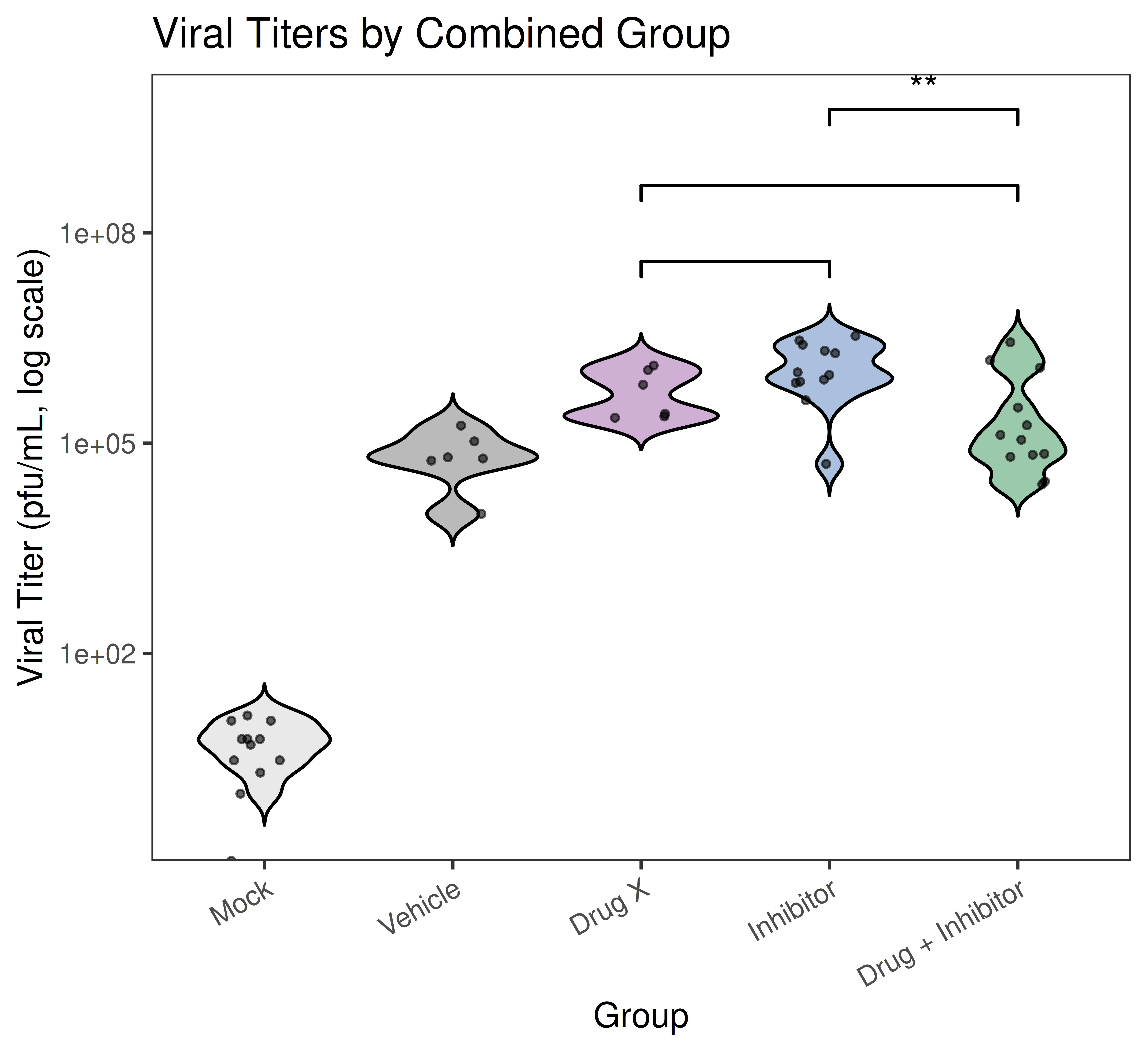
The brackets below carry the Tukey HSD adjusted p-values from the merged-group ANOVA above — the same multiplicity correction as the table, rather than a second, uncorrected set of pairwise t-tests. Comparisons that are not significant at alpha are omitted.

Code
df_plot <- df_clean %>% filter(!is.na(Titer) & Titer >= 0)

# ── Pull the Tukey adjusted p-value for each configured comparison ───────────
# TukeyHSD names its rows "B-A"; look the pair up in either orientation so the
# brackets can never disagree with the table printed above.
tukey_p_lookup <- setNames(tukey_m_tbl$p_adj, tukey_m_tbl$comparison)

tukey_p_for <- function(g1, g2) {
  for (key in c(paste0(g1, "-", g2), paste0(g2, "-", g1))) {
    if (key %in% names(tukey_p_lookup)) return(unname(tukey_p_lookup[[key]]))
  }
  NA_real_
}

p_signif_label <- function(p) {
  dplyr::case_when(
    is.na(p)    ~ NA_character_,
    p <= 1e-4   ~ "****",
    p <= 1e-3   ~ "***",
    p <= 1e-2   ~ "**",
    p <= 0.05   ~ "*",
    TRUE        ~ "ns"
  )
}

# Bracket heights are given on the raw (untransformed) titer scale because
# scale_y_log10() transforms them along with the data.
y_top   <- max(df_plot$Titer_pseudo, na.rm = TRUE)
sig_tbl <- do.call(rbind, lapply(COMPARISONS, function(cmp) {
  data.frame(
    group1 = cmp[1],
    group2 = cmp[2],
    p_adj  = tukey_p_for(cmp[1], cmp[2]),
    stringsAsFactors = FALSE
  )
}))
sig_tbl$label <- p_signif_label(sig_tbl$p_adj)
sig_tbl <- sig_tbl[!is.na(sig_tbl$p_adj) & sig_tbl$p_adj < ALPHA, , drop = FALSE]
if (nrow(sig_tbl) > 0) {
  sig_tbl$y.position <- y_top * 3 * (2.6 ^ (seq_len(nrow(sig_tbl)) - 1))
}

p_combined <- ggplot(df_plot, aes(x = MergedGroup, y = Titer_pseudo, fill = MergedGroup)) +
  geom_violin(trim = FALSE, alpha = 0.45, color = "black", bw = VIOLIN_BW) +
  geom_jitter(width = 0.18, size = 1, alpha = 0.60) +
  scale_fill_manual(values = PALETTE_MERGED, guide = "none") +
  scale_y_log10(labels = scales::label_scientific()) +
  expand_limits(y = y_top * if (nrow(sig_tbl) > 0) 3 * 2.6 ^ nrow(sig_tbl) else 5) +
  labs(
    x       = "Group",
    y       = paste0("Viral Titer + ", PSEUDOCOUNT, " (pfu/mL, log scale)"),
    title   = "Viral Titers by Combined Group",
    caption = paste0("Brackets show Tukey HSD adjusted p-values (alpha = ",
                     ALPHA, "); non-significant comparisons are not drawn.")
  ) +
  theme_bw(base_size = 13) +
  theme(
    axis.text.x      = element_text(angle = 30, hjust = 1),
    panel.grid.major = element_blank(),
    panel.grid.minor = element_blank()
  )

if (nrow(sig_tbl) > 0) {
  p_combined <- p_combined +
    ggpubr::stat_pvalue_manual(
      sig_tbl,
      label        = "label",
      size         = 5,
      bracket.size = 0.6
    )
}

ggsave(file.path(OUTPUT_DIR, "Viral_Titer_CombinedGroups_sig.tiff"), plot = p_combined,
       width = FIG_WIDTH, height = FIG_HEIGHT + 0.5, units = "in", dpi = FIG_DPI,
       compression = "lzw")
print(p_combined)
Code
sig_report <- do.call(rbind, lapply(COMPARISONS, function(cmp) {
  p <- tukey_p_for(cmp[1], cmp[2])
  data.frame(
    Comparison     = paste(cmp[1], "vs", cmp[2]),
    `Tukey adj. p` = p,
    Significance   = p_signif_label(p),
    Bracket        = if (!is.na(p) && p < ALPHA) "drawn" else "omitted (ns)",
    check.names    = FALSE,
    stringsAsFactors = FALSE
  )
}))
knitr::kable(
  sig_report,
  caption = "Configured comparisons and the Tukey HSD adjusted p-values used for the brackets",
  digits  = 4
)
Configured comparisons and the Tukey HSD adjusted p-values used for the brackets
Comparison Tukey adj. p Significance Bracket
Drug X vs Inhibitor 0.9706 ns omitted (ns)
Drug X vs Drug + Inhibitor 0.0000 **** drawn
Inhibitor vs Drug + Inhibitor 0.0000 **** drawn